
 Rated Excellent on Trustpilot


How Much Gold is There in the World?
Estimating the total amount of gold in the world helps investors understand the precious metal's fundamental scarcity, which underpins its value as an investment. All the gold ever mined throughout human history would fit into a cube measuring approximately 21 metres on each side - barely enough to fill three and a half Olympic swimming pools. This remarkable scarcity is one reason why investors turn to gold bars and gold coins for wealth preservation and portfolio diversification.
Total Above-Ground Gold
According to the World Gold Council, approximately 190,040 tonnes of gold has been mined throughout all of human history. This includes gold in jewellery, central bank reserves, investment holdings and industrial applications.
With the density of gold being 19 times greater than water, if you could gather all this gold into one place and form it into a pure gold cube, it would measure just 21.7 metres on each side. Despite thousands of years of mining across every continent, the total amount of gold extracted from Earth remains remarkably limited.
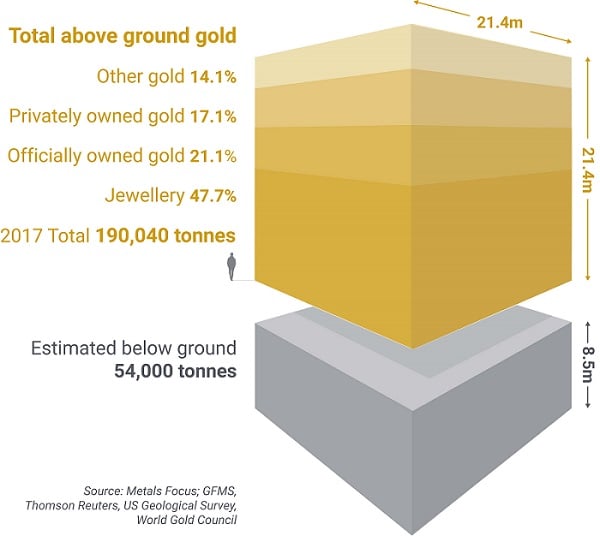
Estimates of the distribution of this above-ground gold show approximately 50% held in jewellery, about 20% held by central banks as official reserves, around 20% in private investment holdings (including gold bullion bars and gold coins), and the remaining 10% in industrial and other applications.
To put this into perspective, the total weight of silver above-ground, which is also considered a rare and precious metal, is believed to be around 1.4 million tonnes. This comparative avaliability has a major impact on the gold to silver price ratio.
Annual Gold Production
Global gold mining produces approximately 3,000 to 3,500 tonnes of new gold each year. This might sound substantial, but it represents only about 1.5% to 2% growth in total above-ground gold stocks annually.
This slow rate of supply growth contrasts sharply with paper currencies, which central banks can expand rapidly through monetary policy. Gold's limited supply growth helps preserve its purchasing power over time, making it attractive as a long-term store of value.
Major gold-producing countries include China, Australia, Russia, the United States, Canada, Peru, Ghana, South Africa, Mexico and Indonesia. However, even with production spread across multiple nations, total annual output remains constrained by the physical difficulty of finding and extracting gold deposits.
Gold in the Earth's Crust
Whilst 190,040 tonnes might be all the gold humanity has mined so far, substantially more gold remains in the Earth's crust. However, most of this gold exists in concentrations far too low to mine economically.
Gold comprises only about 0.004 parts per million of Earth's crust on average. For a deposit to be economically mineable, it typically needs to contain gold at concentrations at least 1,000 times higher than this average - and even then, extraction requires significant investment and sophisticated technology.
Estimates suggest that potentially minable gold resources might amount to another 50,000 to 70,000 tonnes, though only a fraction of this is economically viable to extract at current gold prices and with existing technology. As prices rise or technology improves, previously uneconomic deposits may become viable.
However, despite improved technology, annual production growth has slowed or plateaued in recent years. Many analysts believe the peak of easily accessible gold deposits may have passed, potentially supporting long-term prices as demand continues whilst supply growth slows.
Gold Recycling and Supply
Not all gold entering the market comes from mining. Recycled gold, from old jewellery, industrial scrap and previously owned investment products - contributes significantly to annual supply. In some years, recycled gold can account for 25% to 35% of total supply.
This recycling demonstrates gold's virtually indestructible nature. Gold atoms never degrade or lose their properties, meaning gold mined thousands of years ago retains the same value as freshly refined gold. This permanence adds to gold's appeal as a long-term wealth preservation tool.
Gold in the Oceans
Earth's oceans contain vast amounts of dissolved gold - perhaps 10 to 20 million tonnes. However, the concentration is extraordinarily low, typically around 0.01 parts per billion. Extracting this gold would require processing enormous volumes of seawater, making it completely impractical with current technology.
Scientists have long speculated about ocean gold recovery, but the energy and cost required far exceed the value of the gold recovered. As such, ocean gold remains effectively inaccessible and doesn't contribute to supply.
Why Gold's Scarcity Matters for Investors
Gold's fundamental scarcity, both in terms of total above-ground stocks and slow supply growth - provides important support for its value. Unlike paper assets that can be created in unlimited quantities, gold's supply is constrained by physical reality.
Gold's scarcity becomes even more apparent when compared to other assets. The total value of all gold ever mined at current prices represents only a fraction of global financial assets, property values or stock market capitalisations.
This relative scarcity within the broader investment landscape is one reason why many investors allocate a portion of their portfolios to gold. Even a small percentage allocation to physical gold can provide meaningful diversification benefits whilst taking advantage of gold's unique properties as a tangible, scarce asset.

from £3,186

from £362.90
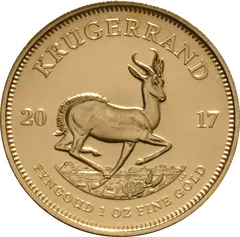
from £363.30
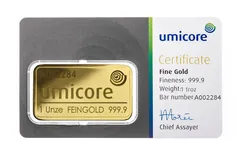
from £3,221