

The Gold Standard
The gold standard (or Gold Exchange Standard) was an international monetary system in which a country's currency is directly linked to a fixed quantity of gold. Under this system, paper money could be exchanged for a set amount of physical gold at any time, and the supply of money in circulation was constrained by the amount of gold held in reserve. In simple terms, gold gave currency its value. Rather than relying on government promises alone, the money in your pocket represented a real, tangible claim on a physical metal with intrinsic worth.
A Brief History of the Gold Standard
Gold has been used as a medium of exchange for thousands of years, but the formalised gold standard emerged in more modern times as nations sought a reliable, internationally recognised basis for trade and currency.
The Classical Gold Standard (1870s–1914)
The United Kingdom adopted the gold standard in 1821, making it one of the earliest nations to do so formally. By the 1870s, most of the world's major economies, including the United States, Germany and France, had followed suit, creating what became known as the classical gold standard era.
During this period, exchange rates between currencies were stable and predictable. A British pound, an American dollar and a German mark each represented a fixed weight of gold, which made international trade and investment considerably more straightforward. Inflation was low and economic confidence was relatively high.
The Interwar Period and the Decline (1914–1944)
The First World War placed enormous financial strain on governments across Europe. To fund the war effort, nations printed money beyond what their gold reserves could support, effectively suspending the gold standard. When attempts were made to return to it in the 1920s, including by the UK in 1925, the conditions were far more difficult, and the Great Depression of the 1930s ultimately made the system unsustainable.
Country after country abandoned the gold standard during the 1930s as governments sought greater flexibility to manage their economies through monetary policy.
Bretton Woods (1944–1971)
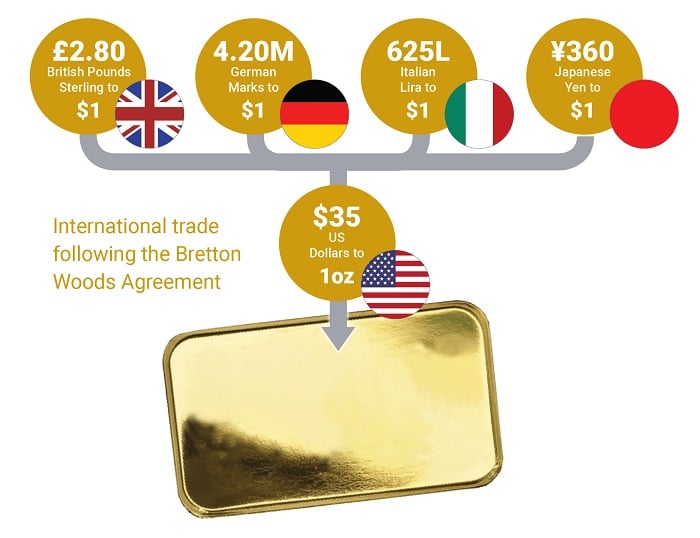
Following the Second World War, the major Allied nations gathered at Bretton Woods in New Hampshire, USA, to establish a new international monetary framework. Under the Bretton Woods system, the US dollar became the world's reserve currency, and the dollar itself was pegged to gold at a fixed rate of $35 per troy ounce. Other currencies were then pegged to the dollar.
This system provided the stability needed for post-war reconstruction and underpinned several decades of economic growth. However, by the late 1960s, the United States was running significant trade deficits and printing more dollars than its gold reserves could justify.

Mount Washington Hotel in Bretton Woods, New Hampshire, United States, where the 1944 international monetary agreement was made.
The End of the Gold Standard (1971)
In August 1971, US President Richard Nixon announced the suspension of the dollar's convertibility into gold. This decision, often referred to as the "Nixon Shock", effectively ended the Bretton Woods system and marked the final departure from the gold standard for most of the world's economies.
Since then, the global financial system has operated on what is known as a fiat currency system, in which money has no direct link to gold or any other physical commodity. The value of currency is instead determined by government decree and market confidence.
Why Did Countries Move Away from Gold?
The gold standard offered genuine benefits: it constrained inflation, encouraged fiscal discipline and provided a stable basis for international trade. However, it also had significant limitations that became more apparent over time.
- Governments found it difficult to respond to economic crises because they could not freely increase the money supply without acquiring more gold.
- Deflationary pressures could become severe, as seen during the Great Depression, when the gold standard prevented the kind of monetary stimulus needed to revive economies.
- The supply of gold is finite and geographically uneven, meaning that a nation's monetary policy could be at the mercy of the output of its gold mines.
- As global trade expanded, the demand for currency grew faster than gold supplies could support.
Fiat currency gave governments greater flexibility, but it also removed a key anchor on the money supply, which is one reason why many investors today turn to physical gold as a store of value in its own right.
The Gold Standard and the Price of Gold Today
Since the end of the Bretton Woods system, the price of gold is determined by global supply and demand on the open market, rather than by a fixed government rate. This means the price of gold can and does fluctuate, sometimes significantly, in response to economic conditions, geopolitical events, currency movements and investor sentiment. While gold no longer underpins the monetary system directly, it remains one of the most closely watched assets in the world.
Why Investors Still Value Gold Today
The end of the gold standard did not diminish gold's appeal to investors, in many ways, it enhanced it. With fiat currencies subject to inflation and the decisions of central banks, many investors view physical gold as a way to preserve wealth outside the conventional financial system.
Whether you are new to investing in gold or looking to add to an existing portfolio, BullionByPost offers a straightforward and secure way to buy physical gold bullion at competitive, live market-linked prices.
Our range includes gold bullion bars in a variety of weights, sourced from major international refineries, as well as a broad selection of gold coins including UK legal tender coins from The Royal Mint.

- Home
- How to Buy?
- Payment Options
- Delivery Options
- Gold Storage
- Storage at Brink's
- Gold Investment Guide
- Why buy gold?
- Is gold a good investment?
- Why Physical Gold?
- Best Time to Buy Gold
- Gold Bars vs Coins?
- Gold vs Silver
- Gold - Silver Ratio explained
- VAT on bullion
- Capital Gains Tax & Gold Bullion
- UK Legal Tender Coins
- Top 5 Gold Investments
- Top 5 Silver Investments
- Gold vs ISAs
- Gold vs Buy-to-Let
- Gold vs FTSE 100
- Gold vs Bitcoin
- Where to buy gold?
- Why buy from us?
- Where to sell gold?
- Coin Shops
- Gold Price Forecasts
- Top 10 Gold Producers
- Top 10 Gold Reserves
- Gold Britannia vs Sovereign
- Britannia coin designs
- Sovereign coin designs
- Sovereign Mintages
- Sovereign mint marks
- British coin specs
- What is a proof coin?
- Royal Mint bullion
- The Queen's Beasts
- Bullion Refiners
- British coin mints
- Gold Tola - India & Pakistan
- Bullion Index
- Home
-
- CGT-Free Gold Coins
- 0.5g Gold Coin
- 1oz Gold Coins
- 1/2oz Gold Coins
- 1/4oz Gold Coins
- 1/10oz Gold Coins
- 2026 Gold Coins
- 2025 Gold Coins
-
-
- Charles III Gold Sovereign Coins
- Elizabeth II Fifth Head 2016 - 2022
- Elizabeth II Fourth Head 1998 - 2015
- Elizabeth II Decimal Head 1974 - 1984
- Elizabeth II Young Head 1957-1968
- George V 1911 - 1932
- Edward VII Gold Sovereign Coins 1902 - 1910
- Victoria Old Head 1893 - 1901
- Victoria Jubilee Head 1887 - 1893
- Victoria Young Head Sovereign
- Gold Double Sovereign
- Gold Quintuple Sovereign
-
-
Show More Show Less
-
-
- Half Sovereign Elizabeth II Fifth Head 2016 - 2022
- Half Sovereign Elizabeth II Fourth Head 1998 - 2015
- Half Sovereign Elizabeth II Decimal Head 1980 - 1984
- Half Sovereign George V 1911 - 1926
- Half Sovereign Edward VII 1902-1910
- Half Sovereign Victoria Old Head 1893 - 1901
- Half Sovereign Victoria Jubilee Head 1887 - 1893
- Half Sovereign Victoria Young Head Shield Back 1838 - 1887
- Half Sovereign George IV Bare Head 1826 - 1828
- Half Sovereign George III 1817 - 1820
-
Show More Show Less
-
- Gold Quarter Sovereign
- American Gold Buffalo
- Gold Tudor Beasts
- Royal Mint Gold Myths & Legends
- The Lion and The Eagle Gold Coins
- St George and the Dragon Gold Coins
- Royal Arms Gold Coins
- Six Decades of 007 James Bond Gold Coins
- Gold Queen's Beasts
- Royal Mint Gold Lunar
- Best Value Gold Coins 1oz
-
- Andorran Coins
- Australian Gold Coins
- Austrian Gold Coins
- British Gold Coins
- Bahamas Coins
- Bahrain Coins
- Belgian Gold Coins
- Botswanan Gold Coins
- Burundi Coins
-
Show More Show Less
- Canadian Gold Coins
- Chilean Gold Coins
- Costa Rican Coins
- Cuban Gold Coins
- Cyprus Gold Coins
- Danish Gold Coins
- Dutch Gold Coins
- Fiji Coins
- Gambian Coins
- German Gold Coins
- Hong Kong Gold Coins
- Hungarian Gold Coins
- Indian Coins
- Irish Gold Coins
- Isle of Man Gold Coins
- Israeli Gold Coins
- Italian Gold Coins
- Jamaican Gold Coins
- Jordanian Coins
- Latvian Coins
- Lesotho Gold Coins
- Macau Coins
- Malaysia Coins
- Maltese Gold Coins
- Mauritian Coins
- Mexican Gold Coins
- Nepalese Coins
- New Zealand Gold Coins
- Pakistani Coins
- Persian Gold Coins
- Peruvian Gold Coins
- Rwanda Gold Coins
- Sardinia Gold Coins
- Saudi Arabian Coins
- Scottish Gold Coins
- Singapore Gold Coins
- Somalian Gold Coins
- South African Gold Coins
- Spanish Gold Coins
- St Helena Gold Coins
- Sudanese Coins
- Swedish Kronor
- Swiss Gold Coins
- Tanzanian Coins
- Thai Coins
- Tonga Coins
- Tunisian Coins
- Turkish Gold Coins
- United Arab Emirates Gold Coins
- Uruguay Gold Coins
- Venezuelan Coins
- Colombian Gold Coins
- Isle of Man Angel
- Isle of Man Gold Noble
- Isle of Man Sovereign
- Somalian African Wildlife Gold Coins
- South African Big Five Series
- 22k Gold Coins
- 24k Gold Coins
- Perth Mint Gold Wildlife Coins
-
-
- CGT-Free Silver Coins
- 1oz Silver Coins
- 2026 Silver Coins
- 2025 Silver Coins
- Silver Coin Sets
- 2oz Silver Coins
- 5oz Silver Coins
- 10oz Silver Coins
- Silver Canadian Maple
-
Show More Show Less
- Austrian Silver Philharmonic
- Perth Mint Silver Lunar Series
- American Eagle
- The Lion and The Eagle Silver Coins
- Royal Mint Silver Myths & Legends
- St George and the Dragon Silver Coins
- Silver Krugerrand
- Chinese Panda
- Australian Silver Kangaroo
- Australian Koala
- Australian Quokka
- Australian Silver Kookaburra
- Australian Silver Brumby
- Australian Silver Wedge Tailed Eagle
- Australian Wombat
- Australian Silver Swan
- Australian Emu
- Silver Armenian Noah's Ark
- Silver Trees of Life Rounds
- Silver Tudor Beasts
- Silver Royal Arms
- Six Decades of 007 James Bond Silver Coins
- Egyptian Relic Series
- Star Wars Silver Coins
- Silver Queen's Beasts
- Marvel Series Superhero Coins
- DC Comics Series Superhero Coins
- Isle of Man Silver Angel
- Rwanda African Ounce
- Czech Lion Silver Coins
- Somalian African Wildlife Silver Coins
- Slovakian Eagle Silver Coins
- Australian Mint Silver Coins
- Isle of Man Silver Noble
- Komodo Dragon
- Mexican Libertad
- Dragon Rectangle Coin
- 1 Kilo Silver Coins
- Pre-Owned Silver Coins
- Pre 1947 British Silver Coins (.500)
- Sterling Silver Coins (.925)
- Silver Proof Coins & Sets
-
-
-
- King Charles III Proof Coronation Coins
- King Charles III 75th Birthday Proof Coins
- Queen Elizabeth II Memorial Proof Coins
- Royal Mint Annual Commemorative Sets
- Royal Mint Lunar Proof Coins
- Music Legends Proof Coins
- Winnie the Pooh and Friends Proof Coins
- Royal Mint Harry Potter Proof Coins
- Royal Mint Star Wars Proof Coins
- The Snowman Proof Coins
- Krugerrand Proof Coins
-
- Platinum Proof Coins and Sets
- Royal Mint 1/4oz Proof Coins
- Royal Mint 1oz Gold Proof Coins
- Proof £2 coins
- Proof £5 coins
-
Show More Show Less
-
-
- Charles I Coins
- Charles II Coins
- Edward I Coins
- Edward II Coins
- Edward III Coins
- Edward IV Coins
- Edward the Confessor
- Edward VI Coins
- Edward VII Coins
- Elizabeth I Coins
-
Show More Show Less
- Elizabeth II Coins
- Ethelred the Unready
- George I Coins
- George II Coins
- George III Coins
- George IV Coins
- George V Coins
- George VI Coins
- Harthacnut Coins
- Henry II Coins
- Henry III Coins
- Henry IV Coins
- Henry V Coins
- Henry VI Coins
- Henry VII Coins
- Henry VIII Coins
- James I Coins
- James II Coins
- King Cnut Coins
- King John Coins
- Oliver Cromwell Coins
- Philip and Mary Coins
- Queen Anne Coins
- Queen Victoria Coins
- Richard I Coins
- Richard II Coins
- William and Mary Coins
- William III Coins
- William IV Coins
- William the Conqueror
- Graded Coins
-
-
- Request an Information Pack
- Sign up to our Newsletter