
 Rated Excellent on Trustpilot


Bretton Woods Agreement
The Bretton Woods agreement was a new monetary system created by world leaders after World War II. It changed the global economic outlook and financial system for much of the 20th century, shaping the modern world.
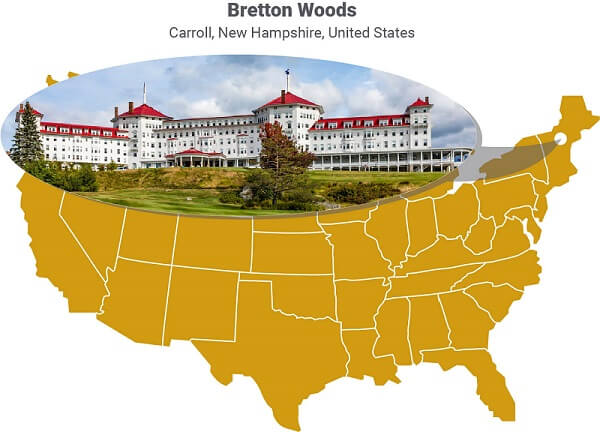
Following the Second World War, the Bretton Woods Resort – more commonly referred to as the Mount Washington Hotel – was the location for the United Nations Monetary and Financial Conference. The conference was held at the hotel in Bretton Woods, New Hampshire, in the United States. With representatives from 44 allied nations, the 1944 conference is now referred to as the Bretton Woods Conference.
The conference established the Bretton Woods System. This post-war international monetary agreement governed financial relations between nations of North America, Western Europe, Australia and Japan. It was a system that dominated trade in the western world for nearly the next thirty years.
The Soviet Union did not attend the Bretton Woods meeting, as it believed the conference would not succeed. Consequently, the Soviet Union went on to form its own system, and this was applied to the communist block of nations under its control.
What Was the Bretton Woods Agreement?
Even before the defeat of Nazi Germany and Japan, the US and UK began planning for a new post-war world. In August 1941, US President Franklin D. Roosevelt and British Prime Minister Winston Churchill met onboard a ship in the North Atlantic. There they signed the Atlantic Charter, which paved the way for the 1944 Bretton Woods Conference. The conference saw representatives from 44 Allied nations gathered at the Mount Washington Hotel in Bretton Woods, New Hampshire, USA, to design a new system for managing international exchange rates and financial relations in the post-war world.
The central objective was stability. The chaos of the interwar years with competitive currency devaluations, trade barriers and the collapse of the earlier gold standard had contributed to the economic conditions that preceded the Second World War. The nations assembled at Bretton Woods were determined to build something more durable. The aim of the Bretton Woods conference was therefore to foster free trade in foreign exchange, and build international economic stability.
There were however different views on how to achieve a more stable world economy. At one extreme; US delegates, led by Harry Dexter White, wanted a return to some form of gold standard. The other extreme, favoured by Britain, was for a new international currency controlled by a world bank. The British delegation was led by famed economist, John Maynard Keynes.
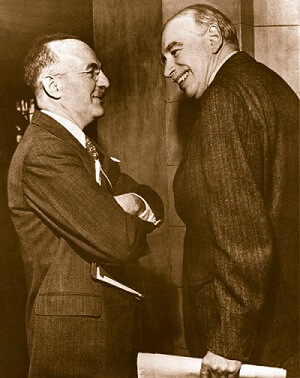
Leader of the US delegation, Harry Dexter White, and leader of the British delegation, John Maynard Keynes, at Bretton Woods.
Keynes saw great need for international controls, regulations and fixed exchange rates. Dexter's opposing vision favoured a more self-regulated system.
The eventual agreement was a compromise agreed by both extremes, but leaning towards the US demands. John Maynard Keynes' proposal for an international currency, which he called the 'bancor', was rejected. He did however succeed in establishing an international bank - the International Bank for Reconstruction and Development (IBRD). Further international control was brought in through the International Monetary Fund (IMF) working with central banks.
Harry Dexter White achieved something close to his wish, with Bretton Woods adopting a pseudo-gold standard. He succeeded by making the US dollar an international reserve currency. This meant that the Dollar became convertible to gold at a rate of $35 per ounce. In theory, America guaranteed a gold exchange for US Dollars - a gold standard centred around a national currency.
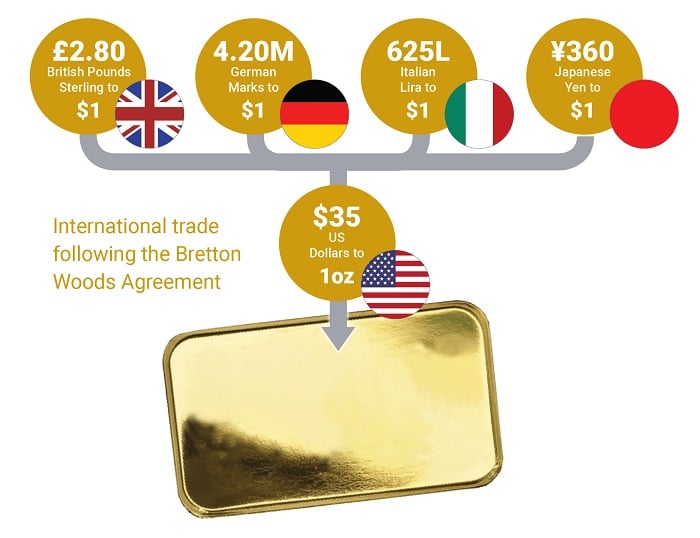
How the Bretton Woods System Worked
The system established at Bretton Woods was built on a clear hierarchy, with gold at its foundation.
The Dollar Peg to Gold
The US dollar was designated as the world's primary reserve currency and was pegged to gold at a fixed rate of $35 per troy ounce. Any foreign government or central bank could, in principle, exchange US dollars for gold at that rate directly with the US Treasury. This made the dollar "as good as gold" in international trade.
Fixed Exchange Rates
All other participating currencies were then pegged to the US dollar at fixed exchange rates. Countries were permitted to adjust their exchange rates only in cases of fundamental economic imbalance, and only with the agreement of the newly created International Monetary Fund (IMF). This arrangement replaced the volatile, uncoordinated currency movements of the 1930s with a predictable, rules-based system.
New International Institutions
The Bretton Woods conference also gave rise to two institutions that remain central to the global economy today:
- The International Monetary Fund (IMF), established to oversee the international monetary system, provide short-term financial assistance to member countries experiencing balance of payments difficulties, and promote exchange rate stability.
- The International Bank for Reconstruction and Development (IBRD), which later became part of the World Bank Group, set up to provide longer-term loans to support post-war reconstruction and economic development.
Why Was the Bretton Woods Agreement So Significant?
The Bretton Woods system provided a stable monetary environment during one of the most remarkable periods of economic growth in modern history. From the late 1940s through to the 1960s, international trade expanded rapidly, exchange rates remained broadly stable, and inflation in most developed economies was kept in check.
For gold, the agreement enshrined its status as the ultimate anchor of the international financial system. The fixed price of $35 per troy ounce meant that gold's role as a reserve asset was formally recognised at the highest level of international cooperation.
For ordinary investors and savers, the system offered a degree of confidence that the money in their hands was ultimately backed by something real and tangible. The knowledge that the dollar, and by extension many other currencies could be exchanged for gold at a fixed rate provided a form of discipline on governments and central banks that pure fiat systems do not impose.
The Strains on Bretton Woods
Despite its success in providing post-war stability, the Bretton Woods system contained structural tensions that became increasingly difficult to manage as the decades passed.
The Triffin Dilemma
Economist Robert Triffin identified a fundamental contradiction at the heart of the system in the early 1960s. For the global economy to grow, it needed an increasing supply of US dollars to use as a reserve currency. But the more dollars the United States issued, the harder it became to maintain the credibility of the $35-per-ounce gold peg, since the volume of dollars in circulation was growing far faster than US gold reserves.
Growing US Deficits
The cost of the Vietnam War and ambitious domestic spending programmes during the 1960s led to significant US budget and trade deficits. More dollars flowed out of the United States than came in, and foreign governments (particularly France) began converting their dollar holdings into gold, drawing down US reserves and placing further pressure on the peg.
Speculative Pressure
As confidence in the dollar's ability to maintain its gold backing eroded, speculative pressure on the system intensified. The gold pool (a cooperative arrangement between central banks to keep the market price of gold close to $35 per ounce) eventually collapsed in 1968, a sign that the Bretton Woods system was under severe stress.
The Collapse of Bretton Woods
The US held huge gold reserves and international demand for US reserve currency naturally increased. Despite this, the cost of the Vietnam war was a huge drain on the US economy, and caused it to weaken significantly in the 1960s and 70s. The eventual economic downturn meant the US was unable to guarantee the commitments it made under the Bretton Woods agreement.
On 15 August 1971, US President Richard Nixon announced that the United States would suspend the convertibility of the dollar into gold. This decision, which became known as the "Nixon Shock", effectively ended the Bretton Woods system.
Attempts were made to salvage a modified version of the fixed exchange rate system through the Smithsonian Agreement of December 1971, which revalued currencies and raised the official gold price to $38 per ounce. However, these efforts proved insufficient, and by 1973 the major world currencies had moved to a system of floating exchange rates.
In 1973, a further 10% devaluation was announced. Finally, in 1976, the Jamaica Accord formally ended the agreement, and completed the collapse of the Bretton Woods system. By 1980, all major currencies were left with on a floating exchange rate international currency market - the fiat monetary system used to this day.
The era of the gold-backed international monetary system was over. Since then, the global financial system has operated on fiat currencies, with no direct link between money and gold.
What Happened to the Gold Price After Bretton Woods?
The end of the Bretton Woods system had a profound effect on gold. Once freed from its fixed $35-per-ounce peg, the gold price was able to move freely in response to market forces for the first time in decades. The results were dramatic. Through the 1970s, as inflation surged and confidence in fiat currencies weakened, gold rose sharply. By January 1980, the price of gold had reached over $800 per troy ounce, more than twenty times its Bretton Woods level. Although gold subsequently fell back and remained subdued for much of the 1980s and 1990s, it entered a new long-term upward trend in the early 2000s.
What Does Bretton Woods Mean for Gold Investors Today?
The history of Bretton Woods offers a clear lesson: gold's value as a monetary anchor has been recognised at the highest levels of international economic governance, and its role as a store of value has outlasted every formal monetary system built around it. Despite its eventual collapse, the Bretton Woods system delivered nearly 30 years of stable international trade. Immediate recession following the economic struggle of the Second World War was broadly averted. The International Monetary Fund, based on John Maynard Keynes' vision, continues to play a vital role in international economic relations today.
For investors today, physical gold continues to be valued for many of the same reasons that made it central to Bretton Woods:
- It is a universally recognised store of value with no counterparty risk.
- It has historically preserved purchasing power over long periods, including during times of high inflation.
- It offers portfolio diversification, as its price does not always move in line with equities or bonds.
- It provides a degree of protection against currency debasement and economic uncertainty.
If you are a current gold investor or considering your first gold investment, BullionByPost offers a straightforward and secure way to invest in physical gold, with live, spot-based pricing and no hidden fees. Our range includes gold bars for sale in a variety of weights from major international refineries, as well as a wide selection of gold coins.
All prices on our website update in real time in line with the current gold price, and every order is dispatched in discreet, fully insured packaging.