
 Rated Excellent on Trustpilot


Fiat currency
A fiat currency is a monetary system in which the value of a nations currency is fixed purely to its exchange rate against other currencies. The term fiat is derived from the Latin 'fieri ', meaning an arbitrary act or government decree.
Fiat currency is better known as ‘paper money’, as it is ultimately backed by paper only. Paper money is becoming something of an outdated term however, with money overwhelmingly turning digital. In many ways this further weakens the strength of a fiat currency, no longer being backed even by physical paper, but electronic and digital means.
Fiat Money
The opposite of fiat money is 'hard currency.' Hard currency is legal tender with a value fixed to its exchange for a physical commodity. Historically, this would have been a precious metal, and overwhelmingly gold and/or silver were the metal of choice.
In a fiat currency, a nation's domestic money supply is determined by the government alone, with no physical asset to back it. This is in contrast to a 'gold standard' where the nation's domestic money supply is directly tied to its reserves of gold. This however has changed in modern economics, with all major currencies switching to fiat money instead.
Old currencies were ‘backed’ (linked) to a metal value. In most cases, a coin was worth it’s literal weight of the metal. This had been the general practice for thousands of years, with the first gold coins dating back to Lydia in the 6th Century BC. 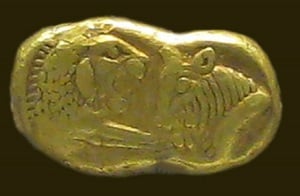
A 6th century BC Lydian electrum coin.
These first coins were a hard currency – their value equalled their precious metal content. They were not pure gold but electrum; a natural alloy of gold and silver found in the vicinity of Lydia’s rivers. Though coins still form a part of the fiat money systems used in the UK and other countries today, their value is simply stated by the issuing government, and is in no real way linked to the metal used to mint them.
Fiat currency meaning
In the 18th century, world trade generally used a hard currency, under the gold or silver standard systems. At this time, governments around the world guaranteed a fixed exchange of gold or silver for their currencies.
In many instances, gold and silver coins contained precious metal equal in value to their currency denomination. To enable this exchange, national central banks and treasuries held large reserves of precious metals.
The United Kingdom had effectively established a gold standard in 1717, and in 1821 it became the first country to officially adopt a currency backed by gold.
This system was maintained until the First World War, which saw metal shortages drive the price up. After WW1, many nations struggled to return their currencies to a gold standard. The huge economic imbalances that followed the war made this difficult for nations with depleted gold reserves, and as a result many economies faltered.
Finally, in the 1930s, world trade was hit by the Great Depression. During this time, the UK abandoned the gold standard, and adopted a fiat currency in 1931. Unemployment however continued to rise, leading to protests such as the Jarrow March in 1936. 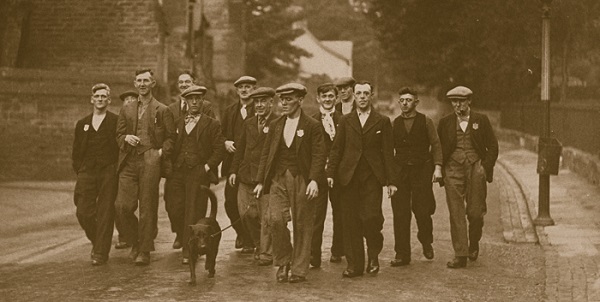
Image of the Jarrow March. Collection of the National Media Museum (photographer unknown).
The Great Depression led many other nations to abandon the gold standard as well. Denmark, Norway, Sweden, Finland, and Japan followed, whilst Belgium, Luxembourg, the Netherlands, Italy, Poland, Switzerland, and France struggled to maintain the standard.
Until the Second World War, international trade continued by wavering between fiat and gold standards. After WW2 however, the victorious nations met to engineer a new economic world order at Bretton Woods in the United States. The British delegation was led by the economist John Maynard Keynes. He opposed a return to the gold standard, believing it had contributed to the pre-war Great Depression. 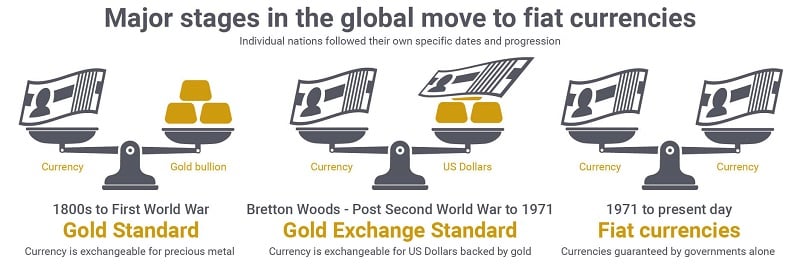
Despite Keynes' misgivings, the Bretton Woods agreement established a quasi-gold standard to be administered by the International Monetary Fund. Under the Agreement, world currencies were fixed to the US Dollar, which in turn was fixed to a value in gold.
With huge federal gold reserves, the US was considered able to guarantee the value of the Dollar in precious metals. The system was described as a "gold exchange standard." In this system, the US guaranteed to exchange a troy ounce of gold for $35 dollars – this theoretically guaranteed the value of other world currencies.
During the 1950s and 1960s there was growing resentment of US economic dominance. Led by France, many nations questioned the ability of America to fulfil its guarantees under the Bretton Woods Agreement.
With the US embroiled in the Vietnam War, these fears seemed to be confirmed. In 1971, the US government - under President Nixon - was forced to alter its exchange guarantee. An ounce of gold went from $35 to $38. In 1973 there was a further increase to $42.22, which effectively ended the gold exchange standard.
From this time on, the majority of currencies can be defined as being pure fiat, paper-based currencies. The values of these currencies were established purely by their exchange rate to other currencies.
The Swiss Franc was the only major currency to maintain a gold standard after 1973, but following a national referendum in May 2000, it too became a fiat currency.
The disadvantages of fiat currencies
There has been great economic debate about the merits of fiat currencies versus hard currencies. Winston Churchill was a strong believer in a gold standard. It was he, as Chancellor of the Exchequer, who pushed through Britain’s return to the gold standard in 1925. 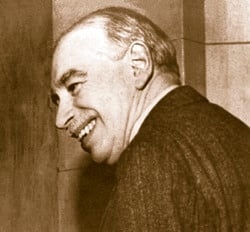
Economist John Maynard Keynes.
Influential economist John Maynard Keynes led the British delegation at Bretton Woods. He advocated the use of fiat money to mitigate economic recessions and depressions. The American delegation however overruled him on several aspects of the final agreement, leading to the eventual quasi-gold standard mentioned above.
The debate between supporters of fiat currencies and the gold standard even continues today; Judy Shelton, economic advisor to former President Donald Trump, is an advocate of a return to some form of gold standard for example.
The major flaw of fiat currency 'paper money' is that without government backing, money becomes totally worthless in many respects. By contrast, hard currency (backed by a precious metal) will always have - and has historically maintained - at least some intrinsic value.
Many economists believe fiat currencies give too much power to national governments. Fiat monetary systems literally gives state authorities the ability to print money. Increasing the money in circulation, without any increase in national production, typically leads to overspending and results in inflation, and in some cases hyper-inflation.
A hard currency such as a gold standard has physical limits in place. These finite limits are set by how much of the metal has been mined, and how much is owned by each individual country. A fiat trade system is intended therefore to be less restrictive, and should in theory allow for greater flexibility and a greater flow of capital. As has been shown all too often though, this flexibility needs to be kept in check, or risk devaluation of a nation’s currency.
Whatever the merits of fiat currencies, gold and precious metals have historically held their value. Read more about why gold remains valuable. Even within a fiat currency system, gold acts as a safe haven investment. This makes physical precious metals useful in a diverse investment portfolio. If fiat currencies were to crash, it is likely that finance systems would return (at least in the short term) to an economy based on gold and/or silver, making it a useful insurance against economic uncertainty.