
Egyptian coins
Egyptian coins cover one of the oldest civilisations in history; a part of human culture dating back to 10,000 BC. Despite this, Egyptian coins didn’t appear until relatively late in its history, as we’ll discuss further below. As a fulcrum point between Europe, Asia and Africa, leadership of Egypt has changed hands several times, and its coinage reflects this.
The Egyptian Relic coin series
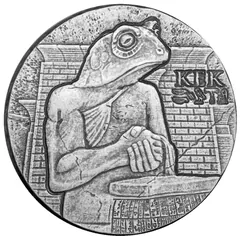
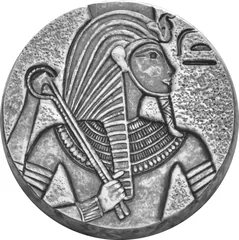
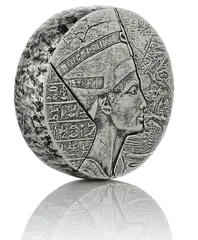
As an interesting aside, the Scottsdale Mint in the United States produces a unique range of Egyptian-themed bullion coins for the Republic of Chad, known as the Egyptian Relic coin series. The series consists of silver coins, produced in larger-than-typical weights, and celebrates Ancient Egyptian civilisation. The coins feature a mixture of famous Egyptian leaders such as Pharaoh Ramesses II, King Tutankhamen and Queen Nefertiti, as well as figures from Egyptian mythology including the God Horus, and the Sphinx of Hatshepsut.
These coins have exquisite designs that mix the unique style of Egyptian culture with a bullion coin, making them a great gift choice for a keen Egyptologist. As far as bullion coins go, these are the most popular Egyptian coins available to modern investors, with no official bullion coin in production by Egypt.
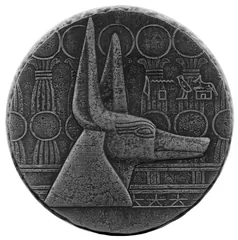
Egyptian Relics Anubis Silver Coin 5oz
from £395.52
Egyptian Relics Kek Silver Coin 5oz
from £395.52
Egyptian Relics King Tut Silver Coin 5oz
from £430.92
Egyptian Relics Queen Nefertiti Silver Coin 5oz
from £395.52
Another series of Egyptian coins, produced by the Pobjoy Mint on behalf of Sierra Leone. These coins centre around the Egyptian Gods, and are available in silver.
Old Egyptian coins
Considering the immense age of the Egyptian civilisation, it is somewhat surprising how few old Egyptian coins are actually found. Egypt was a commercial phenomenon, being known as one of the most fertile and wealthy people of the ancient world.
Such a large country with trade flowing through it had to have some sort of currency. Images of trade do appear in ancient Egyptian art, with scenes of busy market traders bartering items, but it is accepted that barter alone would not be sufficient for such a large civilisation.
Even back in the ancient world, accountants did keep detailed records of transactions, and there are consistent mentions of a currency unit known as a ‘shat’. The shat however does not appear to have been a coin; historians thought it could potentially be a gold ring based on imagery, but none have been found, and historians believe the shat may have been a currency on paper only. Without any evidence of a specific coin, token, or associated item of any kind, the shat remains something of a mystery, one that keeps old Egyptian coins in a state of uncertainty to this day.
What is known for certain is that the Egyptians used one of the oldest forms of a gold standard. As part of this guideline, 7.5 grams of gold was worth one shat, and 12 shats was worth a ‘deben’. All mention of the shat seemed to disappear from records under Pharaoh Ramesses II (1279 – 1212 BC) however.
Gold was very symbolic to Egyptian culture as it was considered a gift from the Gods. This meant that Egyptian leaders wouldn’t have wanted this godly metal associated with monetary coins used in daily life. It is believed that the Egyptians even changed to a silver standard after this period.
The first coins found to be minted in Egypt were relatively late; coming from the late dynastic period of 664 BC – 332 BC. The oldest Egyptian gold coins were known as a ‘stater’, a coin that originated in Greece. The old Egyptian staters were introduced under the Pharaoh Teos, and were minted primarily to pay Greek mercenaries used in a campaign against the Persians. Teos was unpopular however, and was replaced by his nephew Nectanebo II, who struck his own version of the gold stater. There is evidence of some Persian coins also minted in Egypt around this time. 
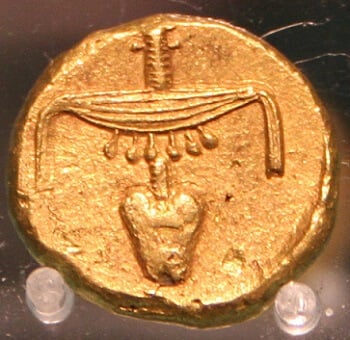
A gold Egyptian Nectanebo II stater. Image courtesy of Wikimedia creative commons.
The Ptolemaic Period (305 – 30 BC) onwards marks the beginning of regular minting of old Egyptian coins. The reign of Ptolemy II in particular saw a rapid increase in the circulation of coins, but these were made mostly of bronze. Unlike the Greeks, Egypt had no silver mines, and had to import silver for use in the production of coins. This made it too expensive for widespread use, but some silver was used for coins up to the time of Cleopatra and the Roman conquest. Silver coins had however been debased to 33% purity by the early BC years. Gold was simply considered too valuable for daily use at this time, but an impressive octodrachm coin was produced, which contained almost one ounce of pure gold.
The Roman conquest of Egypt signalled the end of an era for Egyptian coins, in which Roman coins were introduced, and Egyptian coins slowly phased out of circulation. By the time of Emperor Nero (54 – 68 AD) few Ptolemaic coins remained. For the next 1,800 years Egypt found itself under the rule of the Roman and Byzantine empires, before becoming part of the Fatimid Caliphate, the Mamluk Sultanate, and eventually the Ottoman Empire.
The piastre (ersh) was the Egyptian currency until 1834, and was based on the Turkish kuruş as a leftover from the Ottoman Empire. The Egyptian pound (also known as the geneih) was then introduced in 1834, and a bimetallic standard of gold and silver was adopted. The Maria Theresa thaler in particular was a popular silver coin in the region. The Egyptian pound closely followed the British pound sterling until 1962, when it switched to the US Dollar.
Using a bimetallic standard, Egypt continued to produce gold and silver coins. Between 1837 and 1900 the following coins were struck:
Silver coins: 10 & 20 para coin. 1, 5, 10 & 20 piastre coin.
Gold coins: 5, 10 & 20 piastre coin. 1 pound coin. 
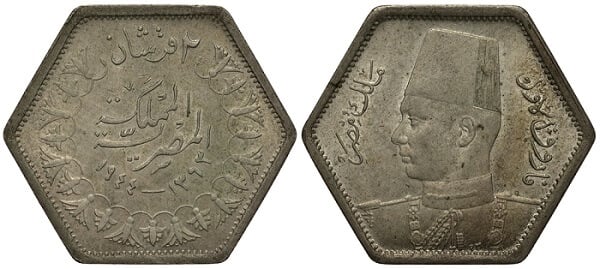
A 1944 2 piastres silver coin; obverse featuring King Farouk.
Gold and silver coins were slowly phased out following 1900, but were reissued in 1916 and 1917. 1922 – 1923 also saw the gold coin range extended to include new 20 and 50 piastre coins, and a 5 pound gold coin. 1944 saw an interesting hexagonal silver coin issued, featuring King Farouk, and was worth 2 piastres, before silver coins were abandoned altogether in 1967.

- Home
- How to Buy?
- Payment Options
- Delivery Options
- Gold Storage
- Storage at Brink's
- Gold Investment Guide
- Why buy gold?
- Is gold a good investment?
- Why Physical Gold?
- Best Time to Buy Gold
- Gold Bars vs Coins?
- Gold vs Silver
- Gold - Silver Ratio explained
- VAT on bullion
- Capital Gains Tax & Gold Bullion
- UK Legal Tender Coins
- Top 5 Gold Investments
- Top 5 Silver Investments
- Gold vs ISAs
- Gold vs Buy-to-Let
- Gold vs FTSE 100
- Gold vs Bitcoin
- Where to buy gold?
- Why buy from us?
- Where to sell gold?
- Coin Shops
- Gold Price Forecasts
- Top 10 Gold Producers
- Top 10 Gold Reserves
- Gold Britannia vs Sovereign
- Britannia coin designs
- Sovereign coin designs
- Sovereign Mintages
- Sovereign mint marks
- British coin specs
- What is a proof coin?
- Royal Mint bullion
- The Queen's Beasts
- Bullion Refiners
- British coin mints
- Gold Tola - India & Pakistan
- Bullion Index
- Home
-
- CGT-Free Gold Coins
- 0.5g Gold Coin
- 1oz Gold Coins
- 1/2oz Gold Coins
- 1/4oz Gold Coins
- 1/10oz Gold Coins
- 2026 Gold Coins
- 2025 Gold Coins
-
-
- Charles III Gold Sovereign Coins
- Elizabeth II Fifth Head 2016 - 2022
- Elizabeth II Fourth Head 1998 - 2015
- Elizabeth II Decimal Head 1974 - 1984
- Elizabeth II Young Head 1957-1968
- George V 1911 - 1932
- Edward VII Gold Sovereign Coins 1902 - 1910
- Victoria Old Head 1893 - 1901
- Victoria Jubilee Head 1887 - 1893
- Victoria Young Head Sovereign
- Gold Double Sovereign
- Gold Quintuple Sovereign
-
-
Show More Show Less
-
-
- Half Sovereign Elizabeth II Fifth Head 2016 - 2022
- Half Sovereign Elizabeth II Fourth Head 1998 - 2015
- Half Sovereign Elizabeth II Decimal Head 1980 - 1984
- Half Sovereign George V 1911 - 1926
- Half Sovereign Edward VII 1902-1910
- Half Sovereign Victoria Old Head 1893 - 1901
- Half Sovereign Victoria Jubilee Head 1887 - 1893
- Half Sovereign Victoria Young Head Shield Back 1838 - 1887
- Half Sovereign George IV Bare Head 1826 - 1828
- Half Sovereign George III 1817 - 1820
-
Show More Show Less
-
- Gold Quarter Sovereign
- American Gold Buffalo
- Gold Tudor Beasts
- Royal Mint Gold Myths & Legends
- The Lion and The Eagle Gold Coins
- St George and the Dragon Gold Coins
- Royal Arms Gold Coins
- Six Decades of 007 James Bond Gold Coins
- Gold Queen's Beasts
- Royal Mint Gold Lunar
- Best Value Gold Coins 1oz
-
- Andorran Coins
- Australian Gold Coins
- Austrian Gold Coins
- British Gold Coins
- Bahamas Coins
- Bahrain Coins
- Belgian Gold Coins
- Botswanan Gold Coins
- Burundi Coins
-
Show More Show Less
- Canadian Gold Coins
- Chilean Gold Coins
- Costa Rican Coins
- Cuban Gold Coins
- Cyprus Gold Coins
- Danish Gold Coins
- Dutch Gold Coins
- Fiji Coins
- Gambian Coins
- German Gold Coins
- Hong Kong Gold Coins
- Hungarian Gold Coins
- Indian Coins
- Irish Gold Coins
- Isle of Man Gold Coins
- Israeli Gold Coins
- Italian Gold Coins
- Jamaican Gold Coins
- Jordanian Coins
- Latvian Coins
- Lesotho Gold Coins
- Macau Coins
- Malaysia Coins
- Maltese Gold Coins
- Mauritian Coins
- Mexican Gold Coins
- Nepalese Coins
- New Zealand Gold Coins
- Pakistani Coins
- Persian Gold Coins
- Peruvian Gold Coins
- Rwanda Gold Coins
- Sardinia Gold Coins
- Saudi Arabian Coins
- Scottish Gold Coins
- Singapore Gold Coins
- Somalian Gold Coins
- South African Gold Coins
- Spanish Gold Coins
- St Helena Gold Coins
- Sudanese Coins
- Swedish Kronor
- Swiss Gold Coins
- Tanzanian Coins
- Thai Coins
- Tonga Coins
- Tunisian Coins
- Turkish Gold Coins
- United Arab Emirates Gold Coins
- Uruguay Gold Coins
- Venezuelan Coins
- Colombian Gold Coins
- Isle of Man Angel
- Isle of Man Gold Noble
- Isle of Man Sovereign
- Somalian African Wildlife Gold Coins
- South African Big Five Series
- 22k Gold Coins
- 24k Gold Coins
- Perth Mint Gold Wildlife Coins
-
-
- CGT-Free Silver Coins
- 1oz Silver Coins
- 2026 Silver Coins
- 2025 Silver Coins
- Silver Coin Sets
- 2oz Silver Coins
- 5oz Silver Coins
- 10oz Silver Coins
- Silver Canadian Maple
-
Show More Show Less
- Austrian Silver Philharmonic
- Perth Mint Silver Lunar Series
- American Eagle
- The Lion and The Eagle Silver Coins
- Royal Mint Silver Myths & Legends
- St George and the Dragon Silver Coins
- Silver Krugerrand
- Chinese Panda
- Australian Silver Kangaroo
- Australian Koala
- Australian Quokka
- Australian Silver Kookaburra
- Australian Silver Brumby
- Australian Silver Wedge Tailed Eagle
- Australian Wombat
- Australian Silver Swan
- Australian Emu
- Silver Armenian Noah's Ark
- Silver Trees of Life Rounds
- Silver Tudor Beasts
- Silver Royal Arms
- Six Decades of 007 James Bond Silver Coins
- Egyptian Relic Series
- Star Wars Silver Coins
- Silver Queen's Beasts
- Marvel Series Superhero Coins
- DC Comics Series Superhero Coins
- Isle of Man Silver Angel
- Rwanda African Ounce
- Czech Lion Silver Coins
- Somalian African Wildlife Silver Coins
- Slovakian Eagle Silver Coins
- Australian Mint Silver Coins
- Isle of Man Silver Noble
- Komodo Dragon
- Mexican Libertad
- Dragon Rectangle Coin
- 1 Kilo Silver Coins
- Pre-Owned Silver Coins
- Pre 1947 British Silver Coins (.500)
- Sterling Silver Coins (.925)
- Silver Proof Coins & Sets
-
-
-
- King Charles III Proof Coronation Coins
- King Charles III 75th Birthday Proof Coins
- Queen Elizabeth II Memorial Proof Coins
- Royal Mint Annual Commemorative Sets
- Royal Mint Lunar Proof Coins
- Music Legends Proof Coins
- Winnie the Pooh and Friends Proof Coins
- Royal Mint Harry Potter Proof Coins
- Royal Mint Star Wars Proof Coins
- The Snowman Proof Coins
- Krugerrand Proof Coins
-
- Platinum Proof Coins and Sets
- Royal Mint 1/4oz Proof Coins
- Royal Mint 1oz Gold Proof Coins
- Proof £2 coins
- Proof £5 coins
-
Show More Show Less
-
-
- Charles I Coins
- Charles II Coins
- Edward I Coins
- Edward II Coins
- Edward III Coins
- Edward IV Coins
- Edward the Confessor
- Edward VI Coins
- Edward VII Coins
- Elizabeth I Coins
-
Show More Show Less
- Elizabeth II Coins
- Ethelred the Unready
- George I Coins
- George II Coins
- George III Coins
- George IV Coins
- George V Coins
- George VI Coins
- Harthacnut Coins
- Henry II Coins
- Henry III Coins
- Henry IV Coins
- Henry V Coins
- Henry VI Coins
- Henry VII Coins
- Henry VIII Coins
- James I Coins
- James II Coins
- King Cnut Coins
- King John Coins
- Oliver Cromwell Coins
- Philip and Mary Coins
- Queen Anne Coins
- Queen Victoria Coins
- Richard I Coins
- Richard II Coins
- William and Mary Coins
- William III Coins
- William IV Coins
- William the Conqueror
- Graded Coins
-
-
- Request an Information Pack
- Sign up to our Newsletter